Generative AI Development Services for Business Automation
Build custom AI assistants, automate content workflows, and deploy LLM-powered tools with Unisam. We deliver generative AI development services that turn large language models into production-ready business applications across Switzerland, Austria, Poland, and Italy.
What We Build as a Generative AI Development Company
Unisam builds generative AI applications that create content, automate workflows, and assist users through natural language. Our generative AI development services cover the full lifecycle: use case discovery, model selection, prompt engineering, RAG implementation, and production deployment.
Our generative AI development services include GenAI apps, LLM tools, AI agents, and automation systems:
We serve clients in Zurich, Geneva, Vienna, Warsaw, Krakow, Milan, and Rome with delivery teams that understand data privacy, GDPR compliance, and the EU AI Act requirements.
Custom AI Assistants
We build AI assistants that answer questions, draft documents, summarize content, and execute tasks based on your knowledge base and business rules. Every assistant is grounded in your data, not generic training corpora.
AI Content Automation
We develop systems that generate marketing copy, product descriptions, reports, emails, and documentation at scale. We implement brand voice controls, fact-checking workflows, and human review gates to maintain quality.
RAG & Knowledge Retrieval
We build retrieval-augmented generation systems that connect LLMs to your documents, databases, and APIs. The AI answers from approved sources with source attribution, reducing hallucination risk and improving trust.
AI Automation & Workflows
Automate repetitive business processes using NLP, vision systems, and ML models.
LLM Integration & Orchestration
We integrate OpenAI GPT, Claude, Llama, Mistral, and custom models into your existing applications. We handle model routing, fallback logic, cost optimization, and performance monitoring across multiple providers.
Prompt Engineering & Tuning
We design prompt templates, few-shot examples, and chain-of-thought workflows that make LLMs reliable and consistent. We test prompts across edge cases and tune for your specific use cases.
Synthetic Data Generation
We build pipelines that generate training data, test scenarios, synthetic content, and simulation environments for machine learning and software testing. This accelerates model development when real data is scarce or sensitive.
Business Problems Our Generative AI Development Services Solve
Our team spends too much time writing repetitive content.
We build AI content automation systems that generate first drafts of emails, reports, product descriptions, and documentation. Human team members review, edit, and approve — cutting production time while maintaining quality control.
We want an AI assistant but can't trust generic answers.
Our RAG-based AI assistants ground every response in your approved knowledge base product manuals, internal wikis, policy documents, and databases. Answers include source citations, and uncertain queries escalate to human experts.
We need to integrate LLMs but don't know which model or provider to choose.
Our LLM integration services evaluate OpenAI, Anthropic, open-source models, and private deployments against your accuracy, cost, latency, and privacy requirements. We implement multi-model orchestration with fallback logic so you're not locked into one provider.
Our customer support team is overwhelmed with routine inquiries.
We build generative AI chatbots and email responders that handle common questions, draft responses, and escalate complex cases. The system learns from past resolutions and maintains your brand voice across all interactions.
We need training data but can't use real customer data due to privacy.
Our synthetic data generation pipelines create realistic, anonymized datasets for model training and software testing. We generate text, structured records, and conversational scenarios that match your domain without exposing sensitive information.
Our team spends too much time writing repetitive content.
We build AI content automation systems that generate first drafts of emails, reports, product descriptions, and documentation. Human team members review, edit, and approve — cutting production time while maintaining quality control.
We want an AI assistant but can't trust generic answers.
Our RAG-based AI assistants ground every response in your approved knowledge base product manuals, internal wikis, policy documents, and databases. Answers include source citations, and uncertain queries escalate to human experts.
We need to integrate LLMs but don't know which model or provider to choose.
Our LLM integration services evaluate OpenAI, Anthropic, open-source models, and private deployments against your accuracy, cost, latency, and privacy requirements. We implement multi-model orchestration with fallback logic so you're not locked into one provider.
Our customer support team is overwhelmed with routine inquiries.
We build generative AI chatbots and email responders that handle common questions, draft responses, and escalate complex cases. The system learns from past resolutions and maintains your brand voice across all interactions.
We need training data but can't use real customer data due to privacy.
Our synthetic data generation pipelines create realistic, anonymized datasets for model training and software testing. We generate text, structured records, and conversational scenarios that match your domain without exposing sensitive information.
RAG with Source Attribution
We connect LLMs to your knowledge base through vector databases, embeddings, and retrieval pipelines. Every AI-generated answer includes references to source documents. Users verify facts, and compliance teams audit outputs.
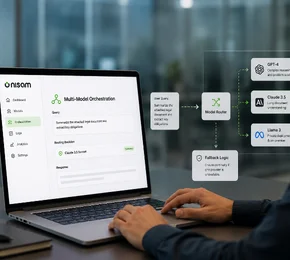
Multi-Model Orchestration
We implement model routing that sends queries to the best LLM for each task: GPT-4 for complex reasoning, Claude for long documents, Llama for private deployments. Fallback logic ensures continuity if one provider is unavailable.
Prompt Engineering & Version Control
We design prompt templates with structured inputs, few-shot examples, and output schemas. Prompts are version-controlled, A/B tested, and optimized for consistency across use cases.

Content Quality Controls
We build human-in-the-loop review workflows, automated fact-checking against source documents, and brand voice enforcement. AI-generated content is flagged for review when it deviates from approved guidelines.

Cost Optimization & Monitoring
We track token usage, model costs, and response latency per query. We implement caching, query batching, and model tiering to control expenses as usage scales.

Secure Deployment Options
We deploy generative AI on your cloud accounts with data residency in EU regions. For sensitive data, we use private models or on-premises deployment. No customer data is used to train public models without explicit consent.
Example Generative AI Use Cases We Can Build
Legal Document Analysis Assistant
A Swiss law firm needs to analyze contracts, extract clauses, and draft summaries faster. We would build a generative AI assistant using RAG connected to the firm's document database. The assistant extracts key terms, flags risks, drafts summaries, and cites source paragraphs, reducing review time while maintaining accuracy through source attribution and human verification workflows.
Multilingual Marketing Content Generator
An Austrian e-commerce company wants to generate product descriptions, email campaigns, and social posts in German, Italian, and English. We would develop an AI content automation system with brand-voice controls, product-data integration, and human-review gates. Content is generated from structured product data and approved messaging templates, not generic web data.

Internal Knowledge Base Assistant
A Polish manufacturing company needs to help employees find information from technical manuals, safety protocols, and training materials. We would build a RAG-powered AI assistant that answers questions from approved documents, provides step-by-step guidance, and escalates unanswered queries to subject-matter experts, with full audit trails for compliance.
Customer Service Email Responder
An Italian insurance company wants to draft responses to routine customer inquiries while ensuring agents review every message. We would build a generative AI system that reads incoming emails, retrieves relevant policy information, drafts personalized responses, and queues them for human approval before sending, maintaining quality control and brand consistency.
Step 1: Use Case Discovery & Feasibility (Weeks 1–2)
01We identify the highest-impact generative AI opportunities in your business. We evaluate data availability, model options, integration points, and ROI potential. Output: prioritized use case roadmap and feasibility assessment.
Step 2: Model Selection & Architecture (Weeks 3–4)
02We test candidate LLMs against your accuracy, cost, and latency requirements. We design the architecture: RAG pipeline, prompt structure, API integration, and fallback logic. Output: model selection report and technical architecture.
Step 3: Prompt Engineering & Prototyping (Weeks 5–8)
03We build prompt templates, few-shot examples, and chain-of-thought workflows. We prototype the core user interaction and test across edge cases, ambiguous inputs, and adversarial queries. Output: working prototype with validated prompts.
Step 4: Integration & Knowledge Base Connection (Weeks 9–10)
04We connect the LLM to your documents, databases, and APIs through RAG pipelines. We implement vector search, document chunking, and metadata filtering. Output: integrated system with live knowledge retrieval.
Step 5: Testing, Deployment & Monitoring (Weeks 11–12)
05We run user acceptance testing, measure output quality, and deploy to production with monitoring dashboards. We set up feedback loops to continuously improve prompts. Output: live generative AI application with performance analytics.
Industries We Serve with Generative AI Development
Contract analysis, document drafting, case research, compliance checking. RAG with legal document databases and human verification workflows.

Product descriptions, email campaigns, social media content, SEO copy. Brand voice controls and structured data integration.

Technical documentation, maintenance guides, safety protocols, training materials. Internal knowledge base assistants with engineering terminology.

Clinical documentation support, research summarization, patient communication drafts. GDPR-compliant handling with no diagnosis or treatment recommendations from AI.

Report generation, regulatory filing support, client communication drafts. Secure deployment with audit trails and human review requirements.

Course content, assessment generation, research summarization, editorial assistance. Citation tracking and plagiarism prevention.
Why Businesses Choose Unisam for Generative AI Development
Businesses choose Unisam for generative AI development because we build RAG-first solutions that deliver grounded, auditable answers, support multi-model flexibility across leading LLM providers, and keep humans in the loop for quality control. With EU data residency, disciplined prompt engineering, and transparent cost management, we create secure, scalable, and reliable generative AI systems that help businesses automate content, improve productivity, and protect compliance.
RAG-First Approach
We don't build AI that guesses. Every generative AI application we deploy uses retrieval-augmented generation, drawing on your approved knowledge base. Answers are grounded, sourced, and auditable, not fabricated from generic training data.
Human-in-the-Loop Design
We design workflows where AI generates drafts and humans review, edit, and approve. This maintains quality control, brand consistency, and compliance while still achieving significant time savings.
Prompt Engineering Discipline
We treat prompts as software version-controlled, tested, and optimized. We don't rely on trial-and-error prompting. Every prompt is designed for reliability, consistency, and maintainability.
Multi-Model Flexibility
We don't lock you into one LLM provider. We orchestrate across OpenAI, Anthropic, open-source models, and private deployments, selecting the right model for each task and maintaining fallback options.
EU Data Residency & Privacy
We deploy generative AI systems in EU cloud regions with data residency guarantees. For sensitive industries, we use private models or on-premises deployment. Your data never trains public models without explicit consent.
Cost Transparency
We track and report token usage, model costs, and response latency. We implement caching, batching, and model tiering to control costs as your usage grows. No surprise bills, no unoptimized scaling.
Frequently Asked Questions About Generative AI Development
Generative AI development is the process of building software applications that use large language models and other generative models to create content, answer questions, and automate tasks. It includes selecting models, designing prompts, implementing retrieval systems, connecting to knowledge bases, and deploying to production with monitoring and quality controls. Unlike traditional software, generative AI systems produce variable outputs that require careful design to ensure reliability and accuracy.
Yes. We build custom AI assistants tailored to your knowledge base, workflows, and business rules. We implement RAG to ground answers in your documents, design conversation flows for your use cases, and integrate with your existing tools. The assistant can answer questions, draft content, summarize documents, and execute tasks — all within your approved guidelines.
Generative AI can automate content creation (emails, reports, product descriptions), document analysis (summarization, extraction, comparison), customer communication (drafting responses, personalizing messages), and knowledge retrieval (answering questions from internal documentation). We focus on tasks where AI generates drafts that humans review, maintaining quality while reducing production time. We do not recommend generative AI for tasks requiring guaranteed factual accuracy without human verification, such as medical diagnosis or financial
advice.
We integrate OpenAI GPT-4 and GPT-3.5, Anthropic Claude, Meta Llama, Mistral, and custom fine-tuned models. We select the model based on your accuracy needs, cost constraints, data privacy requirements, and latency targets. For sensitive data, we recommend private deployments of
open-source models or European-hosted alternatives like Mistral.
We reduce hallucination risk through RAG with approved knowledge sources, confidence scoring, source attribution, and human review workflows. We also implement fallback logic that escalates uncertain queries to human experts rather than generating unverified answers. No
AI system eliminates hallucination risk entirely, but our approach minimizes it through controlled data sources and verification layers.
A focused generative AI MVP with a single use case and RAG integration typically takes 2.5–3 months. Complex multi-model systems, enterprise integrations, or advanced orchestration may take 4–5 months. We provide detailed timelines after the discovery phase.
The cost of generative AI development depends on use case complexity, model requirements, integration scope, and ongoing usage volume. After discovery, we provide a clear estimate with scope, timeline, and delivery phases. We also model ongoing operational costs (token usage, hosting) so you understand total cost of ownership.
Start Your Generative AI Project with Unisam
Whether you need generative AI development Austria, generative AI development Poland, generative AI development Italy, or generative AI development Switzerland, a custom AI assistant, content automation system, or RAG-powered knowledge tool, Unisam delivers generative AI applications that work in production.
Tell us about your use case. We reply within 24 hours with a scope document and approach or Schedule a 30-Minute GenAI Discovery Call to discuss your project with our generative AI team.

Legal & Professional Services